Abstract
Sustained, crewed exploration of Mars presents a fundamental energy challenge, as available solar irradiance is significantly reduced by heliocentric distance and further degraded by dust accumulation and atmospheric scattering. Photovoltaic systems become increasingly area-limited under these conditions, while the scarcity and production limits of suitable radioisotopes constrain radioisotope thermoelectric generators.
These opposing limitations motivate intermediate energy architectures that decouple light collection from direct electrical conversion. This project investigates a solar concentrator system that converts diffuse solar flux into thermal energy before electrical utilization. A segmented array of parabolic mirrors is arranged in a hexagonal geometry to focus sunlight onto a centralized interface that serves a dual function: acting as a heat exchanger for a water-based heat pump system and as a mounting surface for thermoelectric generator modules.
The concentrator was developed through multiple iterations of mirror geometry, informed by optical alignment challenges, focal convergence behavior, and fabrication constraints. Rather than maximizing mirror count, the design emphasizes precision alignment and controlled energy flow, supported by a sun-tracking mechanism using light-dependent resistors and servo actuation. Experimental evaluation focused on validating the sun-tracking system and visually observing light convergence behavior at the focal region, revealing strong sensitivity to angular misalignment and surface imperfections.
1. Executive Overview
Problem Statement
Sustained, crewed exploration of Mars requires energy systems that can operate under reduced solar irradiance, frequent dust accumulation, and limited opportunities for resupply. Photovoltaic systems scale primarily through increased surface area and become constrained by deployment complexity under these conditions, while the availability and production rates of suitable radioisotopes limit radioisotope thermoelectric generators.
The resulting challenge is to develop a scalable surface energy architecture that can operate under reduced and variable solar input without relying on extensive photovoltaic arrays or scarce nuclear materials.
Proposed Solution
This project proposes a solar concentrator architecture that mitigates Martian surface energy constraints by converting diffuse solar irradiance into thermal energy before electrical utilization. A segmented array of parabolic mirrors arranged in a hexagonal geometry focuses sunlight onto a centralized interface that serves both as a heat exchanger for a water-based heat pump system and as a mounting surface for thermoelectric generator modules.
Inspiration
This project started while I was looking into affordable heating and cooling options for my mother's restaurant, which didn't have a centralized HVAC system. Trying to understand why many solutions were either too expensive or poorly scalable pushed me to think more carefully about how energy systems are designed in the first place.
That same line of reasoning led me to draw parallels with space-based energy systems, where resource constraints and efficiency tradeoffs aren't optional considerations but fundamental design drivers.
2. Design Motivation & Constraints
Energy Density Limits
On Mars, solar power is reduced by heliocentric distance and degraded by dust. Photovoltaic systems struggle with non-uniform illumination. This motivates approaches that increase usable energy density without massive footprints.
Square-Root Law
Under concentration, PV current increases linearly while voltage increases logarithmically, leading to diminishing returns. Thermal loading becomes a dominant issue, restricting high-flux PV scaling.
Thermal vs. Electrical
Thermal pathways tolerate high flux and uneven light better than direct electrical conversion. Absorbing light as heat allows for redistribution and buffering, reducing sensitivity to alignment errors.
3. System Architecture
Overall Energy Flow
- Collection: 12 hexagonal parabolic mirrors concentrate sunlight toward a shared zone.
- Redirection: An offset secondary mirror intercepts and redirects the beam to a central target.
- Absorption: The central plate absorbs flux as heat at a controlled interface.
- Utilization: Heat is transferred to the heat exchanger or thermoelectric stack.
Dual-Role Central Element
The central interface acts as both a heat-pump heat exchanger and a thermoelectric generator interface. Combining these roles concentrates optical alignment, thermal collection, and conversion interfaces into a single, mechanically rigid reference point. This reduces part count and alignment degrees of freedom.

4. Optical Design & Fabrication
Mirror Selection
Parabolic mirrors were selected to collimate sunlight into a predictable focal region. A 250 mm hexagonal edge length was chosen to balance manufacturability, stiffness, and handling.
Segmentation & Focal Strategy
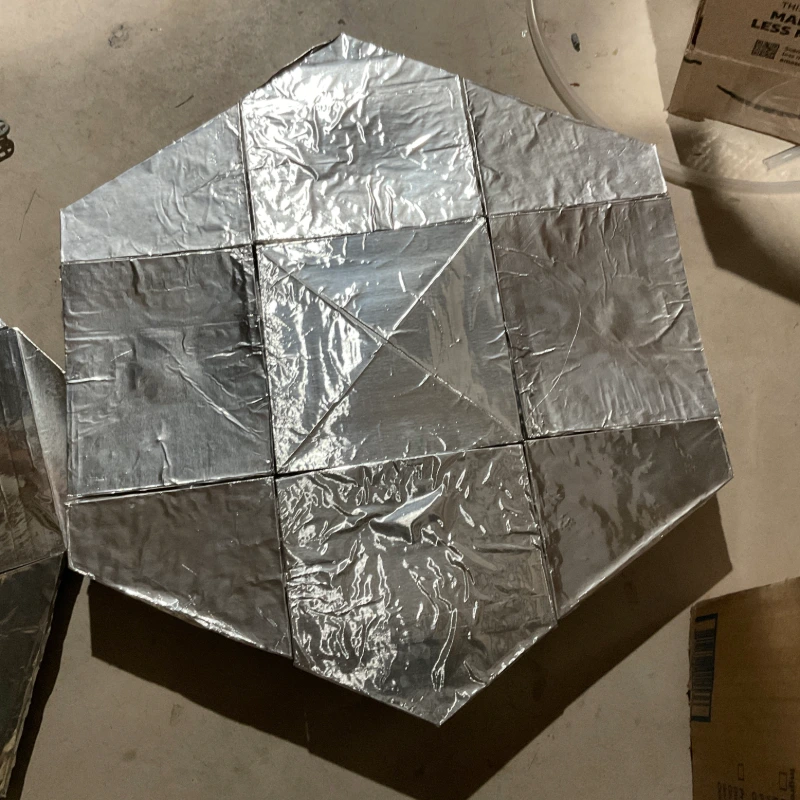
A hexagonal mirror outline was used to maximize packing efficiency around a central target. Instead of forcing all segments to intersect directly at the receiver, the converging beams are intercepted by an offset secondary mirror that redirects the concentrated light onto the central receiver plate.

Iterative Prototyping
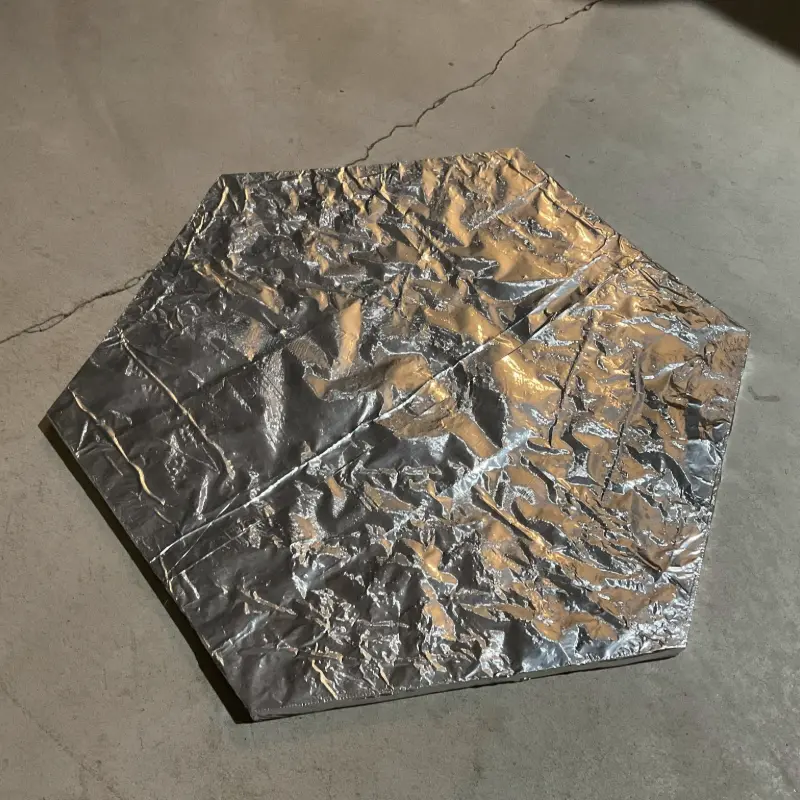
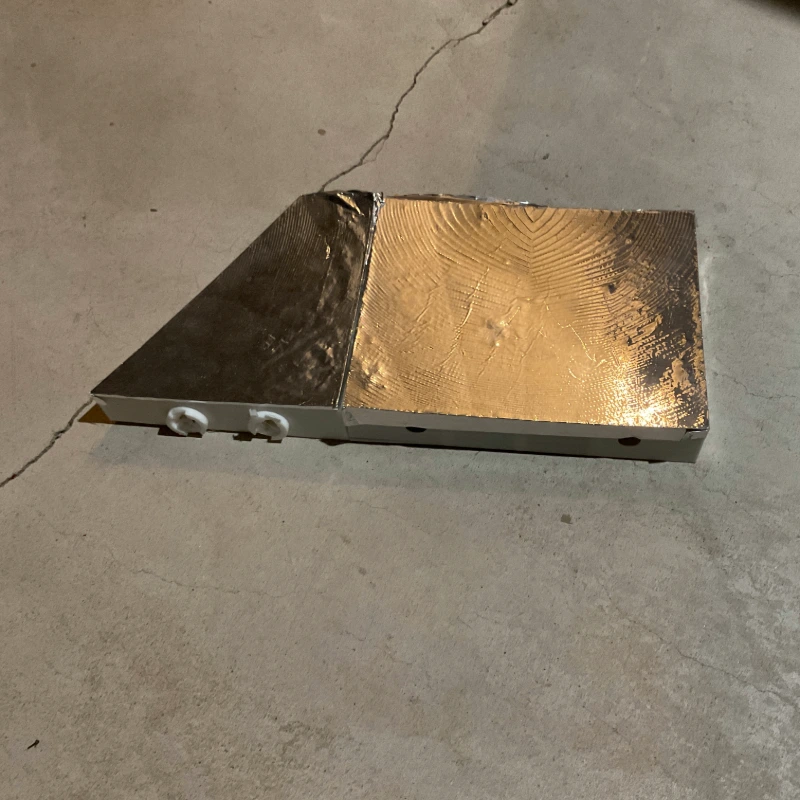
The design evolved through three major iterations to solve manufacturing defects:
Failure: Created protrusions that distorted the mirror surface.
Failure: Warping occurred across unsupported bridge regions.
Result: Better optical quality, though fragile aluminum foil remains a limitation.
5. Tracking & Alignment
LDR Sensor Array
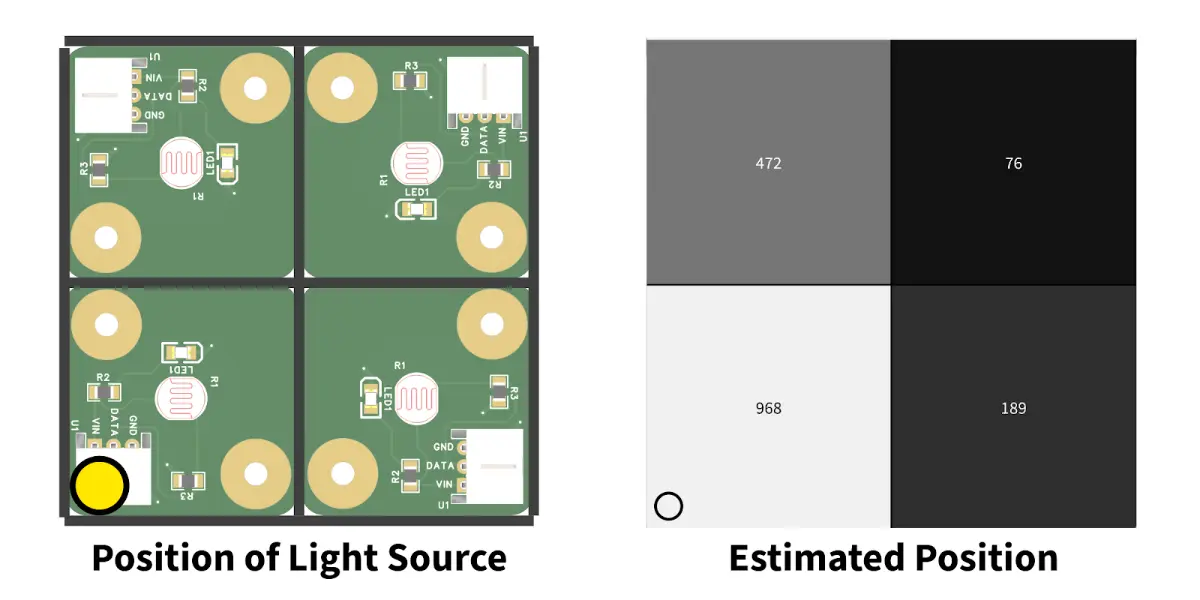
The system uses a Light Dependent Resistor (LDR) array to track the sun. Four sensors are arranged in a quadrant. When the system is aligned, all four sensors report equal light intensity.
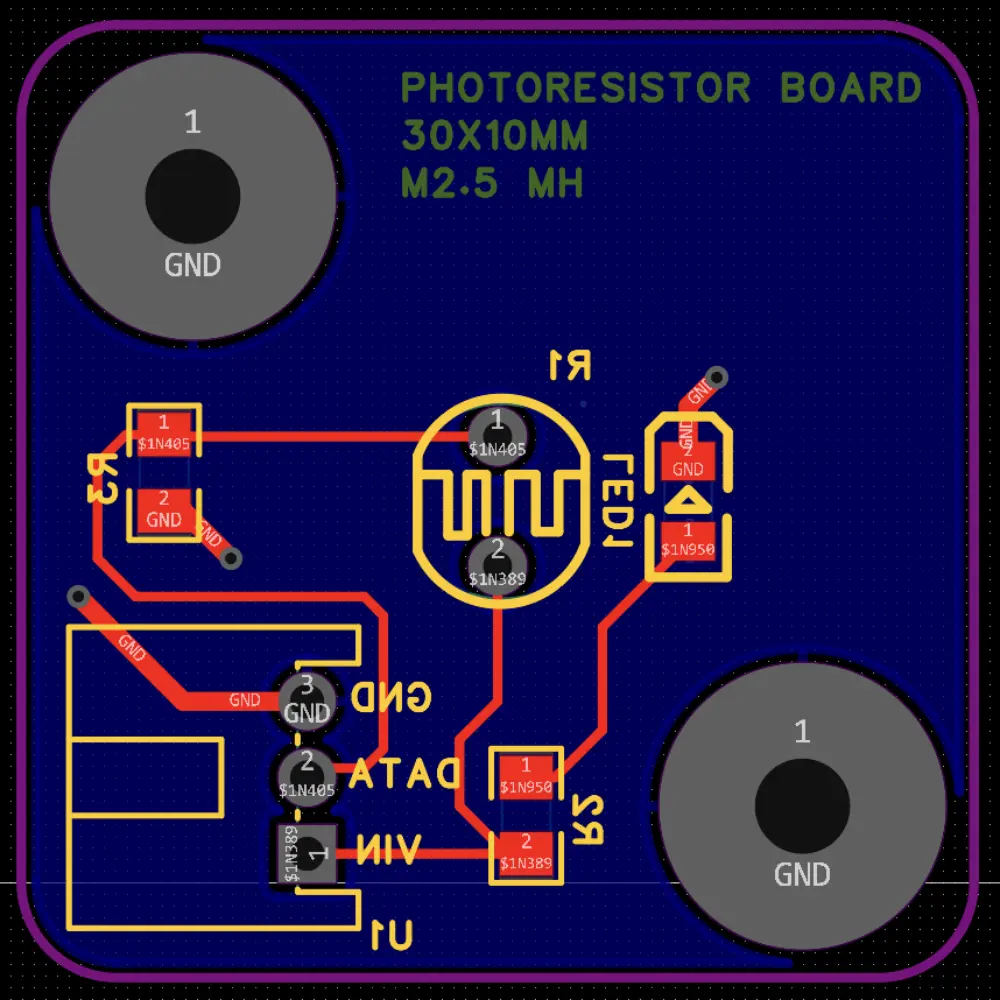
The control objective is not absolute sun position, but the minimization of differential light intensity. This allows the system to self-correct using simple servo motors.
Why Alignment Matters
Maintaining direct optical exposure to the Sun throughout the day maximizes the total collected energy for a fixed system footprint. Even small angular misalignments reduce the duration of effective concentration. Precise alignment increases overall system efficiency by sustaining optimal exposure over time rather than relying on increased mirror count.
6. Thermal Interface & Energy Flow
Concentrated Flux Interface
Converging sunlight from the mirror system is directed onto a central receiver plate, where optical energy is absorbed and converted into thermal energy. This interface serves as the transition point between the optical system and downstream thermal utilization.
Material Considerations
Structural components were fabricated from PETG to simulate the use of plastics in a Martian mission context, inspired by the potential reuse of plastic waste. For optical surfaces, aluminum foil was used to approximate thin reflective sheet materials commonly found on spacecraft.
Loss Mechanisms: Energy losses arise from imperfect reflectivity and beam divergence. The aluminum foil (~80-90% reflectance) introduces greater scattering compared to glass-backed mirrors.
7. Experimental Testing & Observations
Testing Setup
A 1:5 scale prototype was constructed to enable rapid fabrication. The system used four custom LDR sensor modules, two servo motors, and an Arduino Nano. Testing was performed indoors using a handheld flashlight as a controllable light source.
Key Observations
- The LDR-based control system consistently drove the mirrors toward balanced illumination.
- Inconsistencies during fabrication produced noticeable changes in convergence location.
- The system responded reliably even under non-collimated illumination from a flashlight.
8. Future Scalability
- Scientific Data: The tracking sensors can be used to log atmospheric dust and solar variability.
- Battery Buffering: Storing excess thermal energy for night-time release.
- Orbital Reflectors: Using orbital mirrors to redirect sunlight to surface concentrators during Martian night.
- System Scalability: At scale, such an arrangement would resemble a wind farm, where many identical modules contribute collectively.
9. Project Video Presentation
Watch the solar concentrator and tracking system in action.
10. Project Documentation
Access the full technical report and design details.
Download Full Report (PDF)
Click to save the technical documentation.